Article Type: News

The best-selling EVs in China during the first half of 2025

Between January and June, China’s battery-electric vehicle (BEV) market saw domestic competition increase. Meanwhile, the plug-in hybrid (PHEV) sector remained closely contested. Autovista24 special content editor Phil Curry examines the country’s electric vehicle (EV) market with EV Volumes data.

China’s BEV market growth faltered again in June, as it caught up with a strong period of sales in 2024. Overall, 3,498,460 units were delivered in the country during the first half of 2025, a 43.7% year-on-year increase.

However, having peaked at a 50.7% rise in the cumulative figures in April, both May and June saw this figure wane. After exceptional growth in FebruaryMarch and April, improvements were more relaxed in May. June saw an improvement of 39% compared to last year, as 687,277 units were sold in the country.

Meanwhile, the PHEV market returned to an upward growth trend following a wobble in May. The market increased by 36.1% between January and June, with 2,460,588 units taking to Chinese roads.

This was helped by another strong month in June, although the 30.4% monthly increase was the market’s lowest figure since January. Still, the consistent improvements in both BEV and PHEV markets show China’s increasing EV strength.

Geely increases its lead

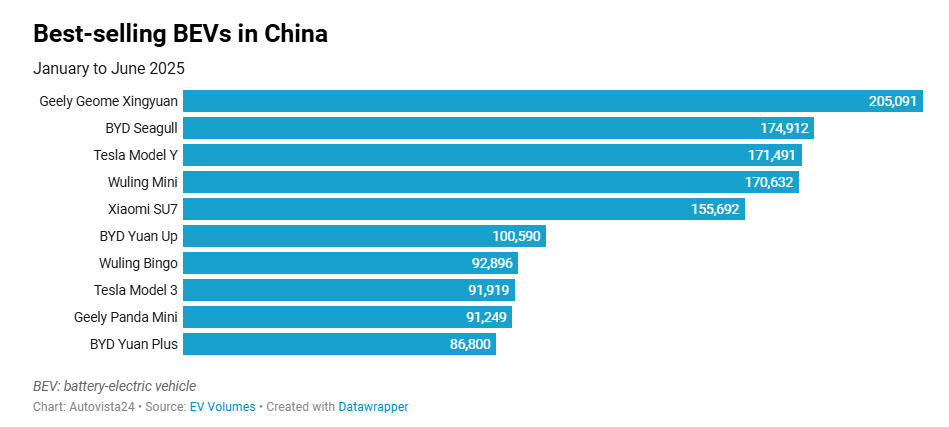
Having reclaimed the top spot in May, the Geely Geome Xingyuan increased its lead in the first half of 2025. The model, which came to the market in September 2024, achieved 205,091 sales between January and June. This meant it made up 5.9% of BEV sales in the country.

June’s outcome created multiple changes in the overall results for the first half of 2025. The BYD Seagull rose to second position, taking a 5% market share with 174,912 units delivered.

This placed it 30,179 behind the Geely model, which has outsold the BYD in five of the six months counted. If the Xingyuan continues its impressive run, it could be difficult to catch.

Tesla’s quarterly delivery boost meant its June results propelled the Model Y into third, from fifth in May. With 171,491 sales, it sits just 3,421 units behind the BYD, taking a 4.9% hold of the market.

The Wuling Mini, which topped the table four months into 2025, slipped back to fourth at the end of June. With 170,632 units delivered, it was just 859 sales behind the Tesla Model Y.

Given the US crossover’s patchy performance in the market in the first half of 2025, the Mini could move up. However, it will need extremely strong results to return to the top of the table.

The fortunes of the BYD, Tesla and Wuling vehicles show the competitive nature of the Chinese market this year. In the first half of 2024, the Tesla Model Y was 50,000 units ahead of the BYD Seagull. This embodied what was a two-horse race 12 months ago. In 2025, the market is more open, with multiple models in the running for the title.

Close competition in China

Fifth went to the Xiaomi SU7 with 155,692 sales. With a 4.5% market share, the model was 14,940 units away from the top four. A further 55,102 units back in sixth was the BYD Yuan Up. It claimed 100,590 deliveries and a 2.9% share of the BEV market in the first six months.

The Wuling Bingo held seventh, with 92,896 units sold and a 2.7% market share. Improving one position to eighth was the Tesla Model 3, benefiting from the brand’s quarterly reporting. It was just 977 units behind the city car, with 91,919 deliveries in total. This gave the BEV a 2.6% market share.

In ninth, the Geely Panda Mini was 670 units behind, having achieved 91,249 deliveries in the first half of 2025. It secured a 2.6% share of the BEV total.

Rounding out the table in 10th was the BYD Yuan Plus, with 86,800 deliveries. Having placed third in the first half of last year, the model has been a victim of increased competition.

Tesla takes the wheel in China

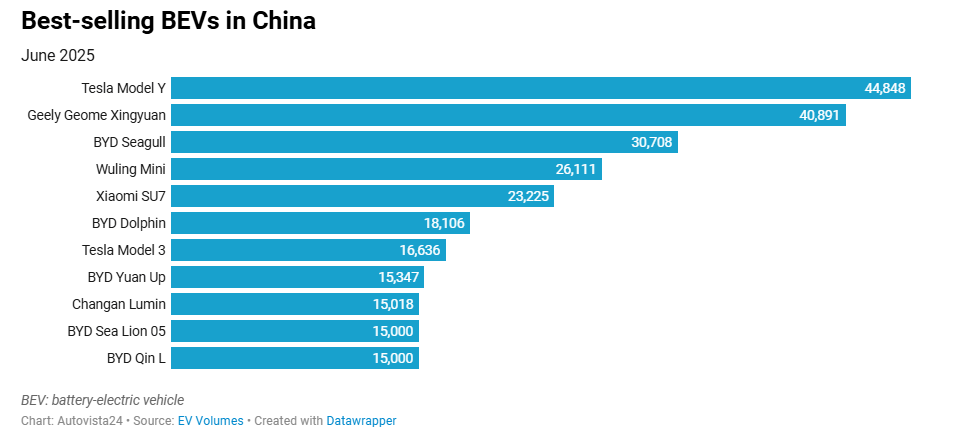
The Tesla Model Y was the best-selling BEV in China during June, thanks partially to the carmaker’s quarterly reporting pattern. It achieved 44,848 deliveries, up 1.7% compared to the same month last year.

This was the model’s best improvement of the year, and only its second across the first six months of 2025. Due to increased competition, its market share fell 2.4 percentage points (pp), to 6.5% in the month.

The Geely Geome Xingyuan continued its impressive performance, with 40,891 deliveries putting it in second. This equated to a 5.9% share of overall deliveries in its 10th month on sale.

The BYD Seagull ended June in third, with 30,708 units taking to Chinese roads. With competition increasing, this was a 12.8% dip compared to last year, while its share of 4.5% was 2.6pp down.

Having struggled in May, the Wuling Mini ended June in fourth and lost further ground to the leading BEV models. It achieved 26,111 deliveries, which was still a 156.3% rise year on year. This also allowed the BEV to grow its market share by 1.7pp, to 3.8%.

Completing the top five was the Xiaomi SU7, with 23,225 units. This was a 62.5% volume increase. It secured a 3.4% hold of the BEV total in the month, up from 2.9%.

BYD on the up

The BYD Dolphin rose to sixth in June with 18,106 deliveries. This was a 114.8% year-on-year improvement, giving the Chinese model a 2.6% market share, up 0.9pp.

Seventh went to the Tesla Model 3, benefiting from the brand’s quarterly reporting. With 16,636 sales, it was 8.3% down on the total achieved in June 2024. This meant its share of the overall BEV total slid from 3.7% to 2.4%.

The BYD Yuan Up took eighth position with 15,347 deliveries, an 82.9% rise. This gave it a 2.2% market share, growing by 0.5pp. In ninth was the Changan Lumin, with its highest monthly sales figure since November 2024. Its 15,018-unit total represented a 70.5% year-on-year improvement, while its 2.2% hold of the market was up 0.4pp.

Two models tied for 10th spot, both of which achieved a record result in their fourth month of sales. This was the BYD Sea Lion 05, making its top 10 debut, and the BYD Qin L. Both recorded 15,000 deliveries in June, equating to a 2.2% share.

Best-selling PHEV declines

There was a sense of status quo in the top four of the PHEV market after six months of 2025. However, the gaps between each ebbed and flowed thanks to each model’s performance in June.

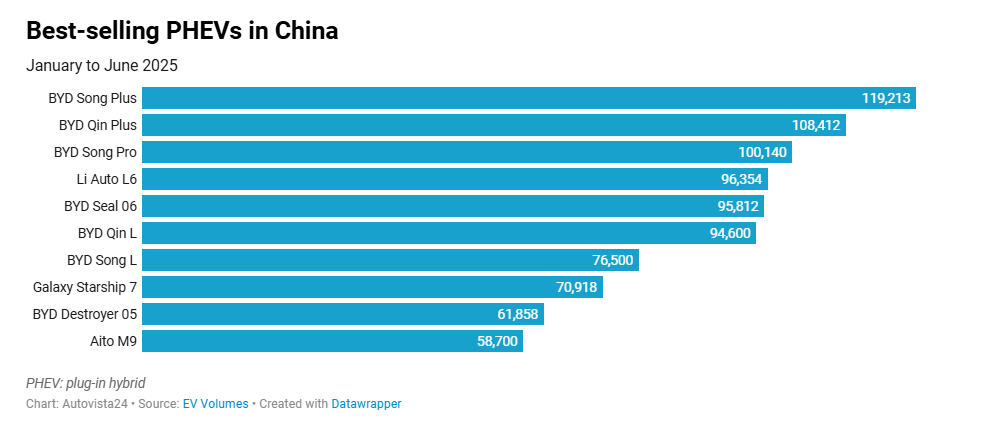
Leading the way after six months was the BYD Song Plus. Despite seeing year-on-year declines in five of the first six months of 2025, its 119,213 total meant it secured first. This translated to a 4.8% market share. However, for the first time since taking the lead in February, its lead over second declined.

Sitting 10,801 units behind in second was the BYD Qin Plus. The model also suffered declines in every month during the first half of 202. However, its volumes were enough to give it a 108,412-unit total. This was enough for a 4.4% market share.

The BYD Song Pro achieved only its second volume improvement of the year in June. This allowed it to hold third six months into the year, although its 100,140 deliveries saw it slip further behind the Qin Plus.

The first non-BYD model in the top 10 between January and June was the Li Auto L6, taking fourth. With 96,354 units, it was 3,786 deliveries behind the top three. However, this was a drop, with the model just 362 units behind in May. Nevertheless, it managed to achieve a 3.9% market share in the six-month period.

The first change in the table occurred in fifth, as the BYD Seal 06 jumped one position. Its strong performance in June left it just 542 units behind the Li Auto L6. The BYD PHEV achieved a total of 95,812 deliveries during the first half.

BYD competes with itself

The rise of the Seal 06 came at the expense of the BYD Qin L, which dropped to sixth. With 94,600 deliveries, it took a 3.8% hold of the market and was 1,212 units behind its stablemate.

Another model making moves was the BYD Song L, which improved to take seventh place. With 76,500 sales, it held a 3.1% market share.

Its rise came at the expense of the Galaxy Starship 7, which dropped to eighth with 70,918 deliveries. This meant it took a 2.9% market share. Having started the year on top, the Starship 7 has not appeared in the last two monthly top 10 standings. This has caused it to drop down the table, although it had maintained seventh position for the three previous months.

The BYD Destroyer 05 re-entered the table in ninth, having dropped out in April. It managed 61,858 sales in the first six months of 2025, equating to a 2.5% share of the PHEV total. Rounding out the top 10 was the Aito M9, with 58,700 deliveries and a 2.4% market share.

Qin Plus moves up

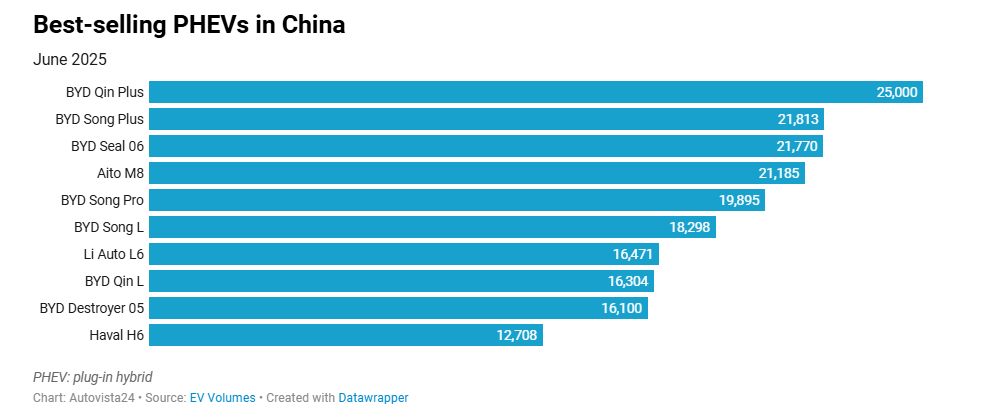
For the first time in 2025, the BYD Qin Plus topped the monthly figures in June. The model achieved 25,000 sales, although this equated to a 29.9% year-on-year drop. The total was enough for a 4.8% market share, which dipped by 4.1pp year on year.

The BYD Song Plus secured second, with 21,813 units taking to Chinese roads in the month. This was a decline of 22.6% year on year. Its hold of the overall monthly PHEV total was 4.2%, down from 7.1%.

Completing BYD’s first top-three lockout since March was the Seal 06. It recorded its best result of the first six months, with 21,770 units delivered. This was a 185.5% year-on-year improvement, while its market share jumped by 2.3pp to 4.2%.

The Aito M8, in only its third month on sale in China, took fourth with 21,815 units. This was a 4.1% hold of the monthly PHEV total. It was the model’s best performance, putting it only 585 units away from the top three.

Fifth went to the BYD Song Pro, with 19,895 sales in June, a 3% improvement over the same month last year. However, with increased competition, the model’s market share fell by 1pp, to 3.8%.

Record results in China

The BYD Song L, which first went on sale in July 2024, was sixth. It achieved 18,298 deliveries in the month, giving it a 3.5% market share.

Following in seventh was the Li Auto L6, with 16,471 sales. This was a decline of 31% year on year, with a 2.8pp fall in market share coming as a result. The model achieved 3.2% of total PHEV deliveries in the month.

Just 167 units back, the BYD Qin L also struggled in June. With 16,304 sales, the PHEV saw a 9.5% drop in deliveries. Its market share declined by 1.4pp, ending the period at 3.1%, as it took eighth place.

A further 204 deliveries behind in ninth was the BYD Destroyer 05. Despite re-entering the year-to-date top 10, it did so due to the poor performances of its competitors. With 16,100 sales, volumes declined 17.2% year on year. This meant its market hold fell from 4.9% in June 2024 to 3.1% this year.

Rounding out the top 10 was the Haval H6, making its top 10 debut with 12,708 units delivered. This was a 584.7% year-on-year improvement.

Despite having launched in September 2022, June was the first time the model achieved a five-digit monthly total. Additionally, the SUV’s June figure was nearly 1,000 units higher than its full-year total in 2024. As a result, its hold of the PHEV total in the month jumped from 0.5% last year to 2.4% in June.

This content is brought to you by Autovista24.
What are the best-selling EV brands in Europe?

Europe’s electric vehicle (EV) market had a resurgent period in the first six months of 2025. But which brands have been able to capitalise on this growth? Autovista24 journalist Tom Hooker goes through the figures from EV Volumes.

EV sales continued to climb in Europe across the second quarter of 2025, according to EV Volumes’ data. A total of 948,203 plug-ins were handed over to customers from April to June, marking a 27.4% year-on-year increase.

So, across the first half of 2025, EV deliveries grew by 23.8% compared to the same period last year. A total of 1,796,162 EVs were sold, equating to a gain of 345,691 units.

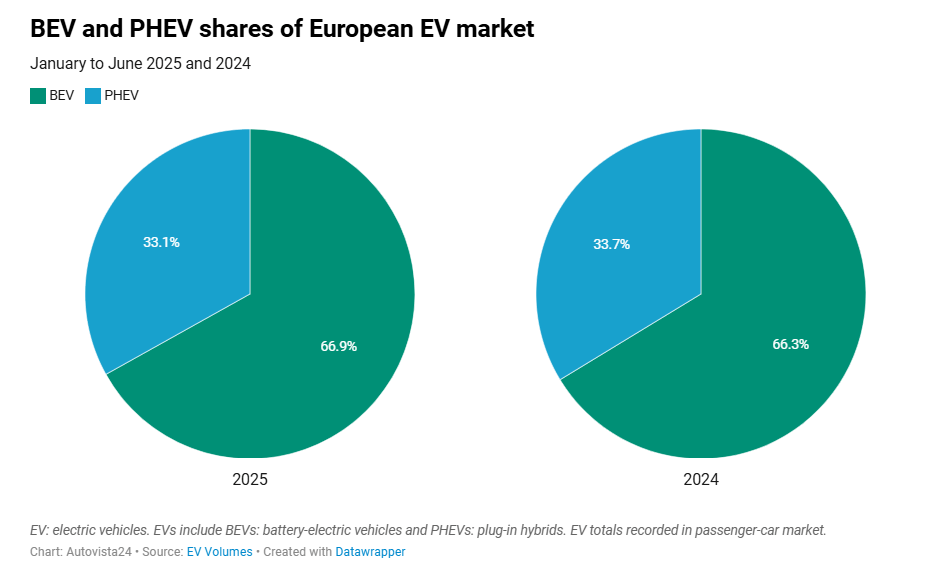
Plug-in hybrids (PHEVs) increased their share of the EV market in the second quarter. The technology accounted for 34.4% of deliveries, up by 2.8 percentage points (pp) year on year. This meant battery-electric vehicles (BEVs) represented 65.6% of sales.

However, across the first half of 2025, the share of BEVs within the EV market grew by 0.6pp to a dominant 66.9%. Consequently, PHEVs made up 33.1% of total deliveries.


Germany leads Europe

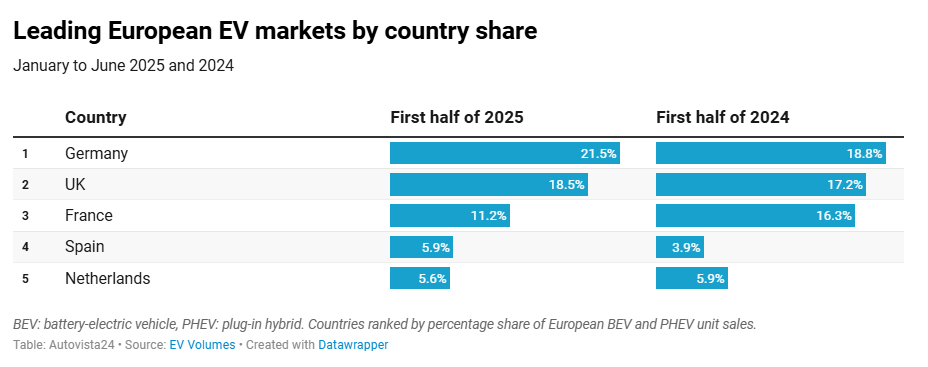
Germany recorded the most EV sales in Europe from January to June. It accounted for 21.5% of all plug-in sales in the region, up 2.7pp year on year. The UK also posted high volumes, representing 18.5% of the European EV total, an increase from its previous 17.2% share.

France was third, making up 11.2% of overall deliveries. However, this was a significant drop of 5.1pp compared to the first half of 2024. Spain was some way behind in fourth with a 5.9%, yet this was a positive progression from its previous 3.9% market hold.

The Netherlands recorded the fifth-highest number of EV sales in the first half. Its 5.6% share was down by 0.3pp from the same period in 2024.


VW’s emphatic EV victory

Volkswagen (VW) led Europe’s EV market six months into 2025. Its market share soared from 6.5% during the same period of 2024 to 11.4% this year.

This was thanks to the brand more than doubling its delivery total. Specifically, 204,805 units were handed over to customers, up 115.8% year on year. The German brand was also the best-selling carmaker in the second quarter.

VW has seen success in both the BEV and PHEV markets. Three of its ID. models featured in Europe’s all-electric top 10 from January to June, making up 56.5% of the carmaker’s EV sales. Meanwhile, its Tiguan SUV led the region’s PHEV market.

VW’s impressive performance has come at the expense of its two domestic rivals, BMW and Mercedes-Benz.

The former still sat in second, however, its market share fell by 0.7pp to 9.2%. This was despite posting a 15.1% sales growth, equating to 164,976 units. The brand enjoyed a solid performance in the second quarter, posting a 17.3% volume improvement.

The iX1 BEV was the manufacturer’s best-selling EV, accounting for 18.8% of its total in the region. The i4 BEV and X1 PHEV also made notable contributions to volumes, recording 14.2% and 12% shares, respectively.

Meanwhile, Mercedes-Benz suffered a 3.5% drop in volumes. The marque’s 121,986-unit total equated to a 6.8% share, down from 8.7%. This decline was driven by an 8.1% fall in sales during the first quarter. However, the brand recovered to record 1.5% growth from April to June.

The carmaker’s two best-selling EVs were the all-electric EQA and EQB. These models represented 16.9% and 14.1% of Mercedes-Benz’s European EV sales, respectively. Its GLC PHEV recorded significant deliveries too, representing 12.9% of the brand’s EV sales.


Contrasting EV fortunes

Tesla finished fourth in the first half of 2025. The US brand endured a 33.4% year-on-year sales decline, with 109,985 deliveries. Many parallels can be drawn between this result and VW’s turnaround.

In the first half of 2025, Tesla took a 6.1% European EV market share. This was 0.4pp below VW’s share at the same point last year. In the first half of 2024, Tesla led the market, representing 11.4% of regional EV sales. This is the same share that VW now controls.

Fifth place went to Volvo, which is struggling to match its 2024 performance. In the first half of 2025, volumes were down 17.2% to 102,533 units, while its share dropped by 2.8pp to 5.7%. The Swedish carmaker saw an even sharper sales decline of 20.9% in the second quarter, putting it seventh.

Conversely, Audi is having a more positive 2025. The marque was just 2,519 units away from entering the top five. This was thanks to a 6.3% improvement in deliveries across the first six months of the year.

The carmaker’s 100,014 EV sales meant a 5.6% share during the first half, down from 6.5% 12 months ago. This drop could be due to the success of VW, which leads the table.

Elsewhere in the group, Skoda saw sales soar as it moved up one spot to seventh. It enjoyed the biggest year-on-year increase of the top 10 brands, with a 154.4% jump to 91,943 units. Its share more than doubled, going from 2.5% to 5.1%. Its second quarter was also exceptional, with a 199.2% rise in deliveries.


Cupra and Kia drop

In turn, Cupra dropped one position to eighth. The Spanish marque saw triple-digit growth in the first quarter, with volumes up 124.6% from January to March. It could not match this performance in the second quarter, but still recorded a 56.4% increase.

This equated to an 84.6% improvement in the first half of the year, while its share rose from 2.9% to 4.3%.

Renault was another manufacturer that started the year well, with a 90% year-on-year rise in volumes during the first quarter. Its sales pace slowed slightly from April to June, as it recorded a 57.9% rise.

This equated to a 72% delivery increase in the first half of 2025, which was enough for it to move into ninth. Accordingly, its market hold rose by 1.1pp to 4.1%.

Kia dropped to 10th, with its 72,457-unit total up 12.5% compared to the first half of 2024. Despite its consistent growth, its share fell from 4.4% to 4%. This decline can be attributed to increased competition and strong sales improvement from other brands.

The brand’s position in the top 10 does not appear secure. Kia was the 12th best-selling EV carmaker from April to June, while BYD came eighth. This marked the Chinese carmaker’s first appearance in Europe’s quarterly table. The Chinese marque enjoyed the biggest year-on-year increase of any brand in the top 10 in the second quarter. Its sales grew by 335.6% to 42,005 units. BYD could enter the annual chart in the third quarter if its sales keep following this trend.

This content is brought to you by Autovista24.
How is used-vehicle retail changing?

Residual value (RV) pressure, emerging Chinese brands, growing profitability and the importance of battery-electric vehicle (BEV) sales. Autovista24 journalist Tom Hooker analyses how and why the landscape of used-vehicle retail is changing.

Industry associations, automotive experts, and carmaker representatives gathered in Frankfurt for the Used Vehicle Retail Summit. The event covered various used-car market topics, including current RV trends, building consumer trust and the sale of BEVs.

Europe’s residual value development

EV Volumes director of content, Christian Schneider, explained how RVs have changed in Europe over the last few years. ‘During the pandemic, because of all the supply shortages, a lot of people were happy that RVs were growing through the roof,’ he explained.

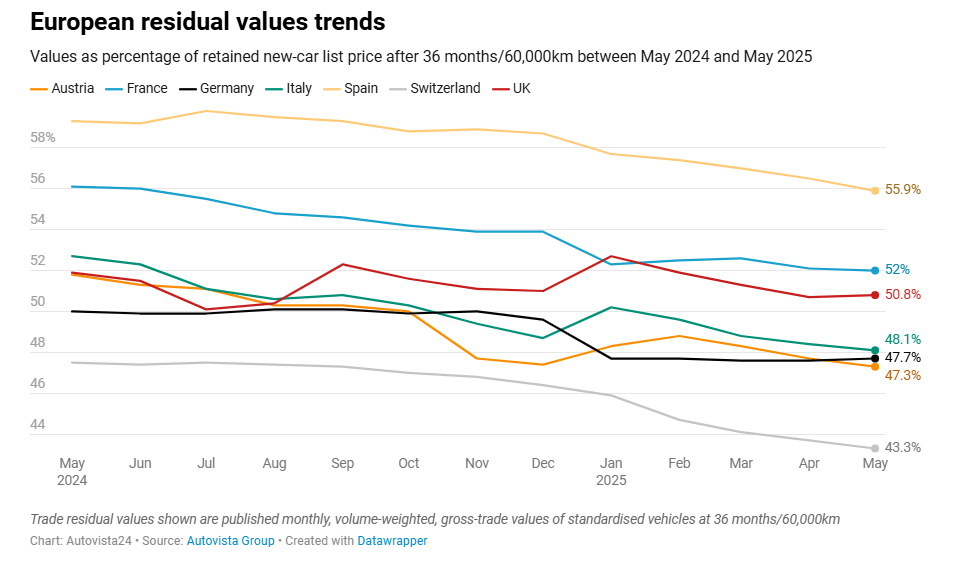
‘But over the last two years, we have seen that across all fuel types, across most countries in Europe, RVs are dropping. They are coming back slightly to a pre-pandemic level, but we still see RVs across various parts of Europe that are above pre-pandemic levels.

‘We see supply and demand balancing a little bit more at the moment. We also see that there is a lot of economic pressure and economies are struggling. So, of course, that has an impact on RVs. For 2025 and 2026, we do not expect the pressure on RVs to get better,’ stated Schneider.

Increased prices

He also noted the impact US tariffs could have on the European used-car market. ‘What we are expecting, if the 25% automotive tariffs stay in place after July, is that the prices for European cars in the US will grow. That also will mean that European export volume to the US will shrink.’

‘But for OEMs, they are producing cars, and they must be sold somewhere. So that means in Europe, you will see increasing volume in our European brands over the next months and maybe even years. This is not a big thing for electric vehicles (EVs), because electrification in the US is not advanced.’

He highlighted that the bigger impact will be on internal-combustion engine (ICE) vehicles. Overall, if higher US tariffs remain after July, there will be additional risk to RVs. EV Volumes is also observing an increasing number of used BEV sales. However, RVs are dropping at an even steeper rate than the overall market.

This is because more BEVs are entering the market than before. However, most of this volume is not coming from private buyers. Instead, it is being pushed through fleet channels.

Furthermore, a lot of the incentives offered in European countries are only offered on the new-car market. These factors are generating an artificial oversupply for used-car markets.

China’s growing influence

Chinese BEV volumes are forecast to continue to grow in Europe over the next few years. Carmakers from China held a 7% share of the European new-car market in 2024. EV Volumes expects this to grow to 10% this year.

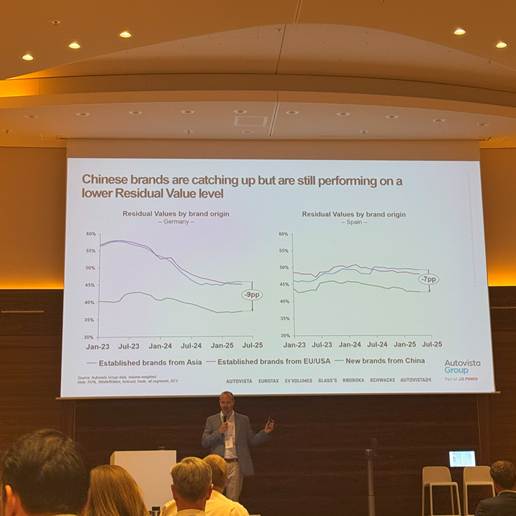
Despite this, RVs of these models still trail behind BEVs originating from other regions. ‘In Germany, Chinese brands are performing nine percentage points (pp) lower than those from established Asian, European or US brands,’ highlighted Schneider.

EV Volumes director of content, Christian Schneider

‘But we saw over time that this is getting smaller. Around one year ago, there was approximately a 14pp or 15pp difference between the brands. So, they are closing the gap, but we still see that the brand reputation takes significant time to fill up, especially for used-car buyers.’

In Spain, this gap is smaller, as the country’s domestic brands are not as strong compared to those in Germany.

Used-car retail

With overall BEV RVs struggling compared to other powertrains, and an increasing number of all-electric models entering the used-car market, how can dealerships survive?

As AECDR secretary general Friedrich Trosse explained, a more effective dealership and communication strategy is needed to keep used-car buyers engaged.

‘The used-car market is going to be the low-income segment of BEVs, because we are never going to have something like a Volkswagen Beetle ever again that is affordable and has modern technology,’ he commented.

For retailers, planning their overall used-car market strategy is also becoming more important, especially when compared to their new-car business.

‘I think that used cars, for retailers and dealers, are an amazing opportunity. In some mature markets, the used-car business is double the size of the new-car business,’ outlined CARA board chairman Luis-Maria Perez-Serano.

‘You can achieve more money and higher margins. Many retailers are now earning more money from used cars than new cars. What is maybe even more important is that used cars are essential for customer retention. They play a major role as the first entry point for buyers,’ he said.

However, Serano added that the used-car market is a complex business. Having a good digital interface is essential for dealers, and he believes more can be done to make the customer’s digital journey easier. This includes showing EV battery health checks online.

Serano also discussed cross-border sales in Europe, and that despite the EU being considered as a single economic market, this is not yet the case for the used-car market. However, improving the facilitation of these sales could create opportunities for retailers who could maximise revenue by moving vehicles to other countries.

Additionally, he stated that there is still a lot to do in terms of educating and training staff in used-car sales and remarketing.

Missed opportunities in retail

‘I still see a lot of missed opportunities in every country. I know most markets have evolved into a more balanced ratio between using new and used cars, but the profitability has not been in the new cars as it has been over the past years,’ explained vice president and chairman of CECRA, Rodrigo Ferreira da Silva.

He also highlighted the importance of the customer having access to accurate in-vehicle data. He advocated for the implementation of a car pass at a European level.

This is a vehicle diagnostic report that provides a certificate to buyers at the time of sale, verifying the vehicle’s mileage accuracy. It has been designed to fight against odometer tampering in the used car market. However, the service is currently only offered in Belgium and the Netherlands.

C

This content is brought to you by Autovista24.
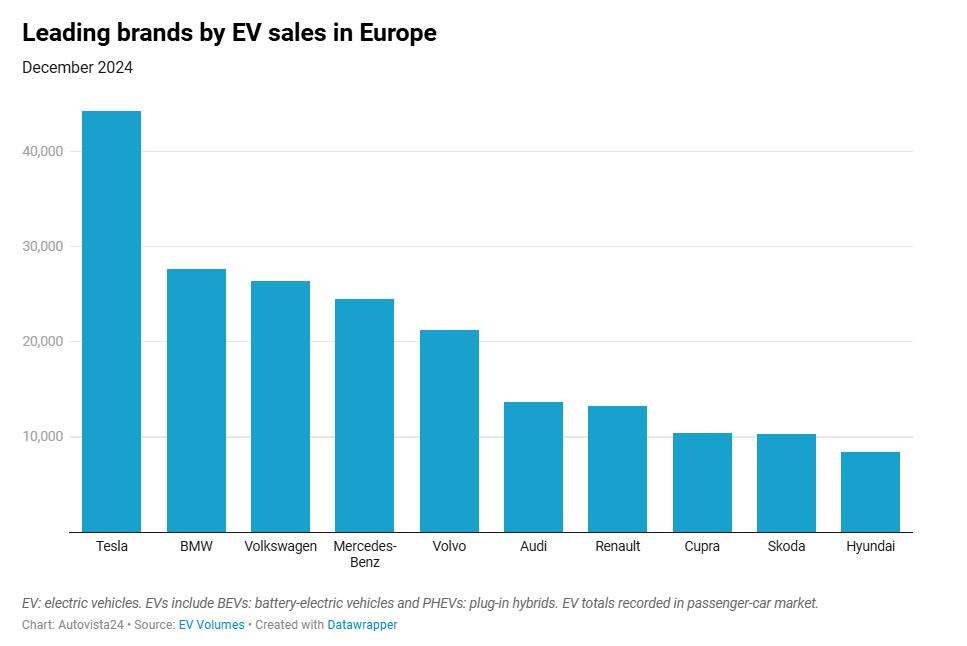
Which brand sold the most EVs in Europe in 2024?

The European electric vehicle (EV) market stalled in 2024, following years of growth. But which carmaker came out on top in the region, and did the gap to the leading brand close? Autovista24 journalist Tom Hooker assesses the data.

Over 2.96million EVs were registered in Europe across 2024, according to the latest data from EV Volumes. This equated to a year-on-year decline of 1.8% and a loss of 55,746 units.

However, EVs did see growth in December, bouncing back after recording a fall in November. Registrations improved by 1.3%, with 298,457 deliveries. This represented a gain of 3,713 units compared to one year ago.

The month saw the highest EV volume total since June 2023. This meant it beat March for the best figures recorded in the year.

Battery-electric vehicles (BEVs) accounted for the majority of the EV market in 2024. The technology accounted for 67.7% of all plug-in registrations, up 0.6 percentage points (pp) from 2023.

Plug-in hybrids (PHEVs) captured 32.3% of the market in the full year, down from 32.9%. The powertrain suffered a sharper delivery decline across 2024 than all-electric vehicles did.

BEVs took a 69.5% share of plug-in volumes during December, a drop of 0.7pp compared to one year ago. PHEVs made up 30.5% of total registrations in the month, up from 29.8%.

Who topped Europe’s EV market?

Tesla topped the European EV market for the third year in a row, with the Model Y and Model 3 leading the continent’s plug-in market at the end of 2024. The manufacturer reached 328,036 deliveries from January to December, more than 35,000 units ahead of second place.

However, this figure was a 10.4% decline on its 2023 performance. The carmaker made up 11.1% of the overall plug-in market, down 1pp year on year.

BMW secured second, replicating its result from 2023. This was thanks to 292,407 registrations, representing an increase of 10.7% or 28,156 units year on year. It also marked the brand’s highest-ever European EV total, helped by its iX1 BEV and X1 PHEV. BMW models accounted for 9.9% of deliveries, up from 8.7% in 2023.

Third place went to Mercedes-Benz, improving on its fourth-place finish in 2023. It posted a record 258,677 registrations. This equated to a growth of 10% and a 23,515-unit gain compared to the previous reporting period.

The improvement was driven by models such as the Mercedes-Benz GLC, which landed third in the region’s PHEV table. This gave the brand an 8.7% share of the total volume, an improvement of 0.9pp.

Volvo finished 2024 in fourth, a significant progression from its sixth-place finish in 2023. Its EX30 BEV performed well, while its XC60 led the PHEV market. The SUV was also joined by the XC90 in the top 10.

The manufacturer reached a best-ever total of 239,255 deliveries, a 42% surge year on year. This was the biggest percentage growth recorded in the top 10 and meant an additional 70,745 models were registered. The manufacturer took an 8.1% share in 2024, up from 5.6%.

VW falls from grace in Europe

In fifth came Volkswagen (VW), falling from third place in the previous year. The carmaker suffered a 6.7% decline in volumes, with 229,836 deliveries. This was a loss of 16,546 units compared to one year ago. VW’s share fell from 8.2% to 7.8% in 2024.

Audi landed in sixth. EV registrations for the brand dropped 0.8% to 172,665 units, meaning it fell one position compared to 2023. This is despite the strong performance of its Q4 e-Tron. Overall, the carmaker’s 5.8% market hold was stable from 2023.

Seventh was taken by Kia, with 118,264 deliveries. Despite matching its 2023 placement, this was a 13% decline in volume compared to one year ago. It equated to a difference of 17,720 units. The marque captured 4% of the EV market, a drop of 0.5pp.

Peugeot took eighth, also replicating its performance from the previous year. However, its total of 115,771 registrations was down 10.9% and 14,174 units year on year. The manufacturer accounted for 3.9% of deliveries, down from 4.3%.

In ninth, Skoda moved up two places from its 2023 result. The carmaker saw volumes rise 4.1% compared to the previous reporting period, with 101,629 deliveries. This was mostly driven by its Enyaq BEV, which represented 78% of the overall figure. Skoda models made up 3.4% of the plug-in market, an increase of 0.2pp.

Hyundai rounded out the top 10, matching its 2023 ranking. Yet, the brand recorded a 14.6% decline in registrations, with 94,258 units. This was a loss of 16,053 units compared to 2023. It took a 3.2% share, falling from 3.7%.

Tesla deliveries grow in Europe

Tesla was the best-selling EV manufacturer in December as it experienced its usual end-of-quarter delivery peak. It last led the market in September 2024. The marque reached 44,257 registrations in the month, a 13.2% growth year on year.

Its two most popular BEVs, the Model Y and Model 3, saw improved volumes in December. This gave Tesla a comfortable gap to the competition, as it sat 16,592 units ahead of second place. The carmaker represented 14.8% of the plug-in market, a rise of 1.5pp from December 2023.

BMW fell to second after leading the market in November. It delivered 27,665 units in the reporting month, a drop of 16.2% compared to one year ago. Yet, December was BMW’s second-highest volume month of the year, with its X1 and X5 PHEVs performing well. The brand accounted for 9.3% of registrations, down from 11.2%.

VW took third, with 26,397 deliveries. This represented year-on-year growth of 17.3%, marking its fourth month of registering around 26,000 units. Notably, demand for its ID.7 BEV and Tiguan PHEV picked up. The manufacturer took an 8.8% market share, an increase of 1.2pp.

Next came Mercedes-Benz, recording 24,528 deliveries, improving by 4.6% from 12 months prior. December represented the marque’s highest volume month since March 2024, as its GLC PHEV posted positive figures. It made up 8.2% of the overall EV total, up from 8%.

Volvo finished fifth in December, thanks to its biggest monthly volume since June 2024. The brand posted 21,194 registrations, a 28.1% year-on-year surge. This equated to a 4,645-unit gain, with its XC60 and XC90 PHEVs recording good growth. Volvo models represented 7.1% of the plug-in market, an improvement of 1.5pp.

European brands fall

Audi secured sixth, with 13,646 deliveries. This equated to a fall of 17.6% compared to 12 months ago, despite its Q4 e-Tron BEV posting growth. Its 4.6% share was down from 5.6%.

Renault saw volumes surge 62.5% in December, benefiting from a strong month for the Renault 5. The carmaker recorded 13,285 registrations, an increase of 62.5% or 5,112 units year on year. This was the highest monthly total since December 2022. The brand accounted for 4.5% of deliveries, up 1.7pp.

Cupra ended the month in eighth, with 10,394 registrations. This was a drop of 6% compared to December 2023, as volumes for its Formentor PHEV struggled. However, December marked Cupra’s biggest delivery month of 2024. The brand made up 3.5% of the overall total, a decline of 0.3pp.

Skoda landed in ninth, posting 10,285 registrations, just 109 units behind Cupra. This was a decline of 0.8% year on year and its lowest volume month since August 2024. Its Enyaq BEV, which makes up the majority of its plug-in deliveries, struggled in December. The manufacturer took a 3.4% share, down from 3.5%.

Hyundai placed 10th, with 8,463 registrations. This equated to a fall of 6% compared to December 2023. The carmaker represented 2.8% of the EV market, a drop of 0.3pp.

This content is brought to you by Autovista24.
Is bigger really better for BEV batteries?

Bigger batteries may remedy range anxiety, but smaller power-storage units can reduce costs and purchase prices of battery-electric vehicles (BEVs). Dr Christof Engelskirchen, chief economist of Autovista Group (part of J.D. Power), explores the economies of smaller batteries.

As the BEV market develops, with carmakers introducing new models, not all brands offer a variety of battery-size options. This is a valid approach, as focusing on larger power-storage units helps to tackle both range anxiety and charging anxiety.

This means peace of mind and conveys an impression of being future-proof. This is especially true as charging infrastructure continues to develop across Europe, where it currently may struggle to meet demand.

Few will question the logic of choosing a larger battery, while selecting a smaller one may raise some eyebrows. But is it rational to opt for the biggest battery unit available, especially as it is the most expensive BEV component? The short answer is ‘it depends’.

To understand whether bigger really is better, some facts need to be unpacked. This can be achieved by comparing the standard and the long-range variants of the Tesla Model Y and Volvo EX30, with a focus on the rear-wheel drive (RWD) single-motor variants.

The Model Y was not only the best-selling car in Europe last year, but it also took the global title. Meanwhile, the recently introduced EX30 emphasises mass-market compatibility, in a vehicle segment where this has been absent for so long.

The cost of greater range

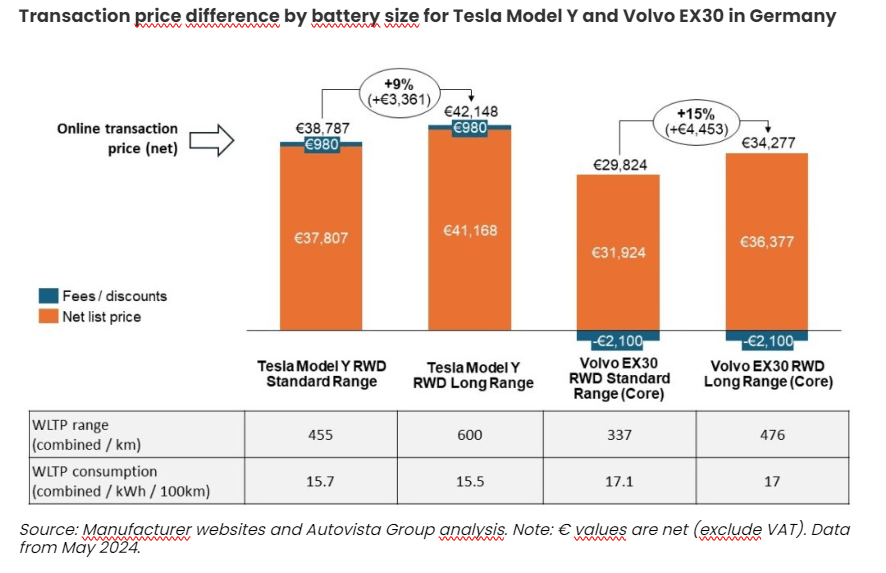
When comparing online transaction prices for new vehicles after fees and applicable company discounts, the initial challenge for bigger batteries is revealed. An additional range of approximately 140km costs between €3,400 and €4,500 (net). This price increase is smaller for Tesla than for Volvo, both in absolute and relative terms.

As a side note, the Model Y is attractively priced, and Volvo needs to offer an additional discount of €2,100 (net) to maintain the required distance between transaction prices. The larger Model Y also offers three times the boot volume of the EX30, while also being around 50cm longer and nearly 10cm taller and wider.

battery

Surprisingly, the WLTP consumption figures do not differ much between each model’s battery variants. In fact, the long-range versions seem to operate more efficiently. Both carmakers use different battery technologies according to the intended range. Their smaller batteries use a lithium-iron-phosphate (LFP) chemistry, while the larger units use a lithium nickel manganese cobalt oxide (NMC) makeup. This is the primary contributing factor to the different battery efficiencies.

Small and economic?

So, how are battery sizes handled in leasing contracts of 36 months and 60,000km? Under its business leasing offer, Tesla charges a moderate €42 (net) per month for more range. This takes the range of the Model Y from an already considerable 455km (WLTP) to 600km (WLTP).

Across one year this accumulates to €504 of additional cost, and roughly €1,500 over three years. This is less than half of what would be paid if the vehicle was purchased outright.

Care by Volvo, the carmaker’s long-term rental and subscription service model, sits at a monthly premium of €59. This adds up to €708 a year and approximately €2,100 over three years. Under this plan, the EX30 goes from a lower range of 337km (WLPT) to a solid 476km (WLTP).

Despite these relatively small uplifts, the price still clearly points towards the smaller battery being the more economical choice. However, it is important to consider how usage impacts utilisation costs. When driving in higher-mileage scenarios, BEVs with a smaller range may require substantially more frequent public charging stops, which are more expensive and less convenient.

Testing with two scenarios

Two scenarios can be used to simulate these economic conditions, alongside certain assumptions.

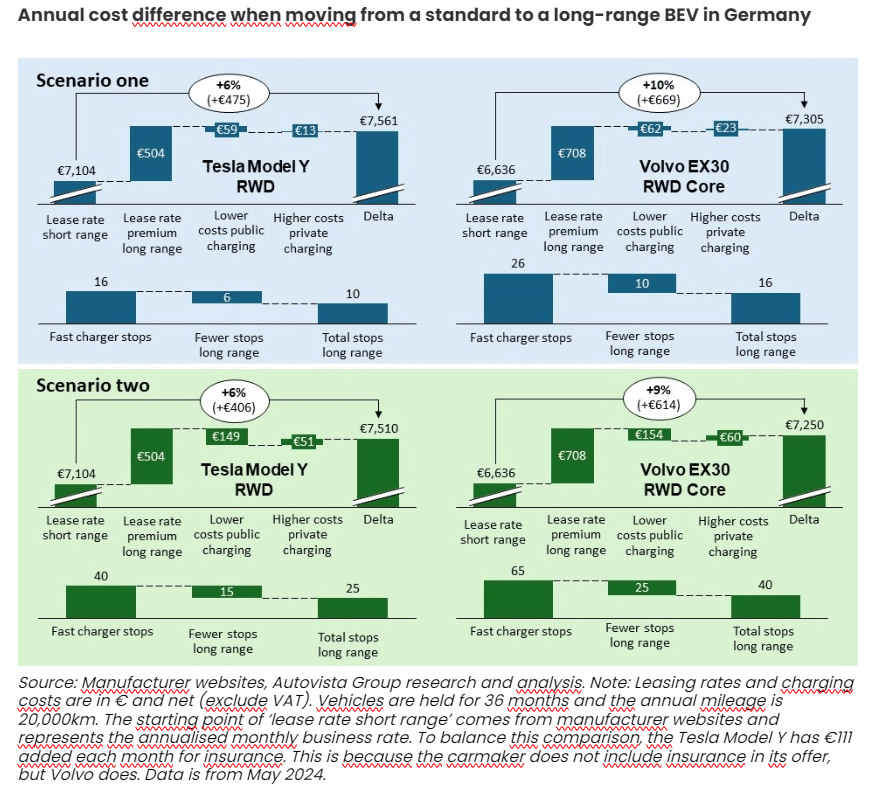
In the first scenario, 80% of the annual 20,000km mileage covers short trips where all charging takes place at home or the workplace. Here, electricity costs are comparatively lower, at €0.25 per kWh (net) in Germany.

The remaining 20% of the annual mileage (4,000km) is made up of long-distance trips. This consists of four short weekend or business trips of 500km each and two larger journeys of 1,000km each.

It is assumed that the driver charges the vehicle to 100% ahead of each trip. Additionally, public charging points are only used when the remaining range reaches 40km, at which point the battery is recharged to 80%. This makes sense in terms of convenience, as it takes roughly the same time to charge from 20% to 80% as it does from 80% to 100%. The costs of fast charging at public infrastructure are set at €0.5 per kWh (net) in Germany.

For the sake of simplicity, real-life ranges are assumed to be 80% of the respective WLTP values for short distances and 65% for longer journeys, conducted at much faster speeds. These assumptions are in line with real-life consumption levels which have been observed, recorded and published in the public domain. Regardless, the overall results are not sensitive to these assumptions.

In the second scenario, the driving pattern is modified so that half of the mileage, 10,000km, is spent on longer trips. This equates to 10 weekend or business trips of 500km each and five longer journeys of 1,000km. The remaining assumptions are unchanged.

Smaller cost savings

Under these scenarios, public-charging costs come down when switching from a short-range model to a long-range one. This is the case for both the Model Y and the EX30, however, the savings are not as significant as some might hope.

The annual cost savings accrued due to less public charging is only between €59 and €62 a year in scenario one and between €149 and €154 in scenario two. Savings partially erode as the car still needs to be charged, albeit at more affordable domestic or company wallboxes.

EV battery

Overall, with net cost savings, it is still more economical to opt for the smaller battery in both scenarios. This means the total cost of ownership (TCO) advantages remain for the smaller battery versions after simulating the more expensive stops at public chargers.

There is a noticeable difference between Tesla and Volvo. The annual TCO difference for the Model Y is only between €406 and €475 in both scenarios. This is because of the smaller premium required for the long-range model versus the standard-range version when compared to Volvo. For the EX30, the TCO difference is between €614 and €669 per year when choosing the larger battery over the standard one.

Calculating convenience

The added convenience of fewer public charging stops must also be considered for those BEVs with a bigger battery.

The standard Tesla Model Y offers such a good range it can handle the use case of scenario one quite well, requiring only 16 stops a year. Meanwhile, the long-range version reduces the annual number of stops from 16 to 10.

Here, the case for a smaller battery may be economically apparent, but for many people, the long-range version offers added flexibility at a small additional cost.

Here, the case for a smaller battery may be economically apparent, but for many people, the long-range version offers added flexibility at a small additional cost.

The longer-range variant of the Volvo EX30 reduces the number of stops more significantly from 26 to 16. Therefore, the added convenience of the longer-range version is considerable, but then so is the price premium. This makes it a tie in terms of choice, with budget and actual use case the likely deciding factors.

In scenario two, the standard-range Model Y makes 40 stops a year at public chargers. This will be enough to push most customers towards the long-range version. The TCO disadvantage of the bigger battery comes down to only €406 a year, or €27 per saved stop.

Similarly for the EX30, investing the additional €614 a year in scenario two would make sense. This would bring the stops down to 40 from 65 with the standard range version and costs €25 per saved stop.

A balanced decision

So, if the price or leasing rate increase for a larger battery is small, going big will mean an extra layer of convenience and security. This also reduces stress on developing infrastructure, with more stops requiring more chargers.

If the cost uplift is more substantial, smaller batteries will still deliver, while remaining the more economical choice. This is especially true if shorter trips define a person’s driving pattern.

However, when longer journeys underline a person’s driving pattern, it will be worth assessing the number of stops needed with the given battery variant. This will ensure a well-balanced decision between added costs, extra flexibility and greater convenience.

This content is brought to you by Autovista24.
Träffa bilen som suger upp koldioxid och rengör luften

Autovista24

Tänk dig en bil som samlar upp mer koldioxid än den släpper ut under körning. En grupp studenter vid Eindhoven University of Technology (TU/e) i Nederländerna har gjort den tanken till verklighet i form av elbilsprototypen Zem.

Zem lagrar koldioxid genom ”direkt luftinsamling” medan den kör. Den rengör och släpper sen ut luften genom ett särskilt filter. Projektet befinner sig i ett tidigt stadium, men teamet vid TU/ecomotive ser utvecklingen som motiverande. Syftet är att bidra till en minskad global uppvärmning, samtidigt som det poängterar att personbilar ansvarar för över 60% av bidragande utsläpp.  

Nyckeln till Zems förmåga att effektivt suga upp koldioxid från atmosfären är filtret. Bilen kan i dagsläget färdas 320 km innan enheten når full kapacitet och behöver bytas ut eller rengöras. Den unika komponenten, vilken TU/ecomotive söker patent för, låter bilen samla in två kilo koldioxid vid en årlig körsträcka på 33 000 km. Det innebär att tio Zem-prototyper skulle kunna lagra lika mycket koldioxid som ett genomsnittligt träd under ett år.

– Det är fortfarande ett koncepttest men vi kan redan se att vi kommer att kunna utöka filtrets kapacitet under de kommande åren. Att lagra koldioxid är en förutsättning för att kunna kompensera för utsläpp som sker vid tillverkning och återvinning, sa teamchef Louise de Laat.

En snygg bil med ett seriöst budskap

Man kan lugnt säga att resultaten kan bli besynnerliga när uppstartsföretag rullar ut banbrytande prototyper. Men Zem är däremot en snygg och sportig coupé med två dörrar. Den är lätt att föreställa sig susandes fram längs framtidens vägar.

Bilens hållbara budskap är förstärkt genom tillverkningsprocessen. Alla material och delar av fordonet går att återvinna eller återanvända. TU/ecomotive har samarbetat med Black Bear Carbon, en koncern som även den är baserad i Eindhoven och som specialiserar sig på att återanvända gamla bildäck. De här materialen inkorporeras i uppbyggnaden av Zems monocoque-kaross. Det är en process som är central i minskandet av koldioxidutsläpp.

Tvåvägsladdning är något som många bilföretag och laddleverantör fortsätter att utveckla, och Zem utnyttjar den processen till fullo. Tekniken möjliggör för så kallad vechicle-to-grid (V2G) eller vehicle-to-home (V2H) energiförsörjning, där elbilen levererar energi från sitt batteri, antingen tillbaka ut i elnätet eller direkt till ett hus. Den kan därför ge kraft till hushållsapparater och annan icke-fordonsspecifik utrustning, eller användas för att jämna ut uppgångar i allmän efterfrågan på energi.

Zems teknik för tvåvägsladdning har parats ihop med solpaneler som har byggts in i bilens tak, vilket nyttjar bilens båda batterier och utrymmet på taket för att göra bilen mer hållbar även när den inte körs.

I samarbete med partners så som CEAD och Royal3D har TU/ecomotive även använt sig av 3D-printing under byggprocessen. Zems monocoque-kaross och yttre kaross har skapats med hjälp av den här metoden, vilket markant drar ner svinnmaterial tack vare cirkulär plast som kan malas ner och återanvändas för andra projekt.

I över ett årtionde, har teamet vid TU/e utvecklat fordon med fokus på hållbarhet och uppvisat sådan teknik för bilindustrin. Det lilla teamet har som mål att bygga en ny, innovativ bil var tolfte till artonde månad.

– Vi vill väcka intresse hos industrin genom att visa vad som redan är möjligt, bekräftade Nikki Okkels, ansvarig för externa relationer vid TU/ecomotive. Om 35 studenter kan utforma, utveckla och bygga en närmast koldioxidneutral bil på ett år, så finns det tillfällen och möjligheter även för industrin.

– Vi uppmanar industrin att anta utmaningen, och vi vill såklart mer än gärna hjälpa dem att tackla den. Vi är själva inte klara med vår utveckling än och vi vill ta stora kliv framåt under de kommande åren. Vi bjuder med en varm hand in biltillverkare till att komma och ta en titt.

Detta innehåll presenteras till dig av Autovista24.

Vänligen notera att denna artikel är en översättning av originalet som publicerades på engelska på Autovista24´s hemsida och kan innehålla mindre grammatiska fel. I händelse av diskrepans eller inkonsekvens mellan översättningen och den engelska versionen, ska den engelska versionen alltid ha företräde.

Ta mig till Autovista24

Lanseringsrapport: Kia Niro EV sticker ut i den mycket konkurrenskraftiga CUV-klassen

Autovista24

Kias Niro har satt riktmärket för biltillverkarens utbud av elbilar. Den tidigare modellen, som går under namnet e-Niro, visade på Kias stora intresse för marknaden, och de har sedan dess lanserat EV6 och planerar för ytterligare modeller under de kommande åren.

Namnet Niro fortsätter att vara en central del av Kias planer för företagets elektriska framtid, vilket framgår av den senaste modellen. Niro EV följer det koreanska företagets nya designkoncept, med en texturerad grill som genomskärs av en slät list. Det är bakom listen som den elektriska laddningspunkten återfinns på elbils- och laddhybrids-versionerna.

Den bakre delen av Niro EV har en utsvängd stil, med smala LED baklyktor som sveper ner från taket och slutar mitt på karossen, medan den kurvade linjen fortsätter ner mot hjulhuset. Detta får bilen att se ut som att den är ett med vägen.

Aeroblade förhöjer stilen

Ytterligare ett tillskott i utformningen, Aeroblade, hjälper till med denna balansövning. Det består i praktiken av en vinge på vardera sida av bilen, mitt mellan taket och hjulhuset på C-stolpen återfinns en öppning med räfflor framför som hjälper till att leda luften.  Det minskar vägbuller och förbättrar aerodynamiken, vilket bidrar till en ökad räckvidd. Aeroblade är dessutom ett designinslag och har en färg som kontrasterar mot den övriga karossen. Köpare kan dock välja att få hela bilen i samma färg.

Den stilrena och eleganta interiören är tillverkad från material av hög kvalitet och erbjuder en avslappnad miljö. Två 10.25” skärmar stöder styrning av funktioner och infotainment, med användarvänliga menyer och grafik som gör de mer lättanvända än vissa konkurrerande system. Klimatanläggningen hanteras med knappar och rattar, vilket gör det mindre komplext än vissa system där biltillverkare har valt att styra hela systemet med touch-funktioner.

Bilen erbjuder Vehicle-to-Load-teknik (V2L), vilket redan finns tillgängligt i Kia EV6. Tekniken gör det möjligt att koppla in enheter i ett vanligt eluttag i bilen. Praktikalitet går även att notera i bagaget som har en kapacitet på 475 liter, vilket är betydligt större än några av de konkurrerande modellerna.

Ökar räckvidden och priset

Kia Niro EV finns tillgänglig som hybrid, laddhybrid och elbil. Elbilsmodellen erbjuder en räckvidd på 460 km med en batterikapacitet på 64.8 kWh. Medan det är starkare än vissa av konkurrenterna så hade modellen med fördel kunnat haft ett större batteri och längre räckvidd; särskilt då elbilsmarknaden fortsätter att expandera och större modeller vinner på att ha en räckvidd på över 480 km. Detta kan också vara ett hinder för förare av tjänstebilar som är i behov av längre räckvidd.

Med den nya modellen har priserna stigit. Det är särskilt markant om man jämför med föregångaren e-Niro. Den är nu dyrare än vissa av sina närmsta konkurrenter, och även om utformning, material och användbarhet har förbättrats så räcker det kanske inte för att köpare ska överväga det högre priserna. Kia erbjuder dock sju års garanti för Niro EV, vilket kommer att erbjuda en viss trygghet för de som funderar på att köpa en modell som är tre till fyra år gammal.

CUV-klassens konkurrenskraftighet ökar allt eftersom biltillverkare tar fram nya modeller och särskilt allt eftersom elbilar ökar i popularitet. Då den är en vidareutveckling av sin tidigare generation har Kia Niro EV chansen att glänsa, med förbättrat utseende, bättre köregenskaper samt med en ökad kännedom om märket på elbilsmarknaden.

Detta innehåll presenteras till dig av Autovista24.

Vänligen notera att denna artikel är en översättning av originalet som publicerades på engelska på Autovista24´s hemsida och kan innehålla mindre grammatiska fel. I händelse av diskrepans eller inkonsekvens mellan översättningen och den engelska versionen, ska den engelska versionen alltid ha företräde.

Ta mig till Autovista24

Utvärdering av avancerat förarstödsystem med Euro NCAP

Autovista24

Bilindustrin har uppnått flertalet milstenar för säkerhet. Säkerhetsbälten, krockkuddar och deformationszoner har alla hjälpt till att rädda liv. Men varför nöja sig med reaktiva åtgärder när proaktiva funktioner kan hjälpa till att undvika kollisioner?

Avancerade förarstödsystem (ADAS) verkar kunna lova just det. Men teknologin behöver utvärderas noggrant för att industrin ska veta vad som fungerar. Här kliver Euro NCAP in i bilden. Autovista24:s biträdande redaktör Tom Geggus och Adriano Palao, teknisk chef för ADAS och självkörande fordon hos Euro NCAP, diskuterar framtiden för bilsäkerhet.

Prenumerera på Autovista24:s podcast och lyssna på tidigare avsnitt på AppleSpotifyGoogle Podcasts eller Amazon Music.

Sammanfattning av avsnittet

Synonymt med slowmotion-videor av krocktest, så är Euro NCAP kända för sina praktiska tillvägagångssätt när det kommer till att testa bilsäkerhet. Palao förklarade att Euro NCAP siktar på att främja säkerhetssystem som överskrider minimikraven för typgodkännande.

Då alltmer avancerad självskörande teknik skapar nya förutsättningar för bilar så har den internationella organisationen utvärderat och rangordnat avancerade förarstödsystem. – Körsäkerhetstesten är uppdelade inom områden för oskyddade trafikanter och säkerhetsassistans, berättade Palao.

Skydd för oskyddade trafikanter inkluderar tester av automatiska nödbromsar (AEB) för gångtrafikanter, cyklister och från nästa år även motorcyklar. Säkerhetsassistansen hanterar i stället car-to-car AEB, system för hastighetsstöd, körfältshjälp och övervakning av förarens tillstånd.

Euro NCAP testade nyligen de avancerade förarsystemen i Nissan Qashqai, Volkswagen ID.5, Polestar 2 och Jaguar I-Pace. Resultaten uppvisade den snabba takt i vilken självkörande säkerhetsteknik utvecklas. Ännu mer imponerande var det att ett av de bäst presterande fordonen som testades även var ett av de mest prisvärda. – Jag tycker att det är imponerande att ett av de mest prisvärda fordonen i testet fick högsta poäng både i stjärnklassificering och i assisted driving-gradering, kommenterade Palao.

Men Euro NCAP är inte begränsade till att enbart testa personbilar. Till följd av en lavinartad ökning i intresse under Covid-19 så undersöks även ADAS:en som förkommer i lätta motorfordon. – Då mängden lätta motorfordon ökar runt om i världen anser Euro NCAP att det är av yttersta vikt att inkludera den sortens fordon i bedömningssystemet. De som ansvarar för fordonsflottorna förstår vikten av säkerhet för sina företag, sade Palao.

Euro NCAP kritiserades nyligen i en artikel om körfältshjälpsteknologi i Carwow. I den förekom ett citat från Matthew Avery, styrelseledamot för Euro NCAP och chef för strategisk forskning hos Thatcham Research, där han sa att säkerhetsorganisationens tester hade lett till att biltillverkare utrustar med ”spårkänslig” teknik. Palao förklarade organisationens ställning och sa att Euro NCAP:s bedömning av körfältshjälp är relevant på grund av risken som finns i oavsiktlig avvikelse från vägbanan och eventuella resulterande kollisioner.

När han blickar framåt mot deras färdplan för 2030 kunde Palao även ge en smygtitt på vad som komma ska för Euro NCAP. Efter att ha träffat bilföretag har säkerhetsorganisationen övervägt effekterna av högre nivåer att automatisering och fordonssäkerhet i sin helhet.

Detta innehåll presenteras till dig av Autovista24.

Vänligen notera att denna artikel är en översättning av originalet som publicerades på engelska på Autovista24´s hemsida och kan innehålla mindre grammatiska fel. I händelse av diskrepans eller inkonsekvens mellan översättningen och den engelska versionen, ska den engelska versionen alltid ha företräde.

Ta mig till Autovista24

VW:s trådlösa mjukvaruuppdatering för elfordon utökar räckvidden och tillför nya funktioner

Autovista24

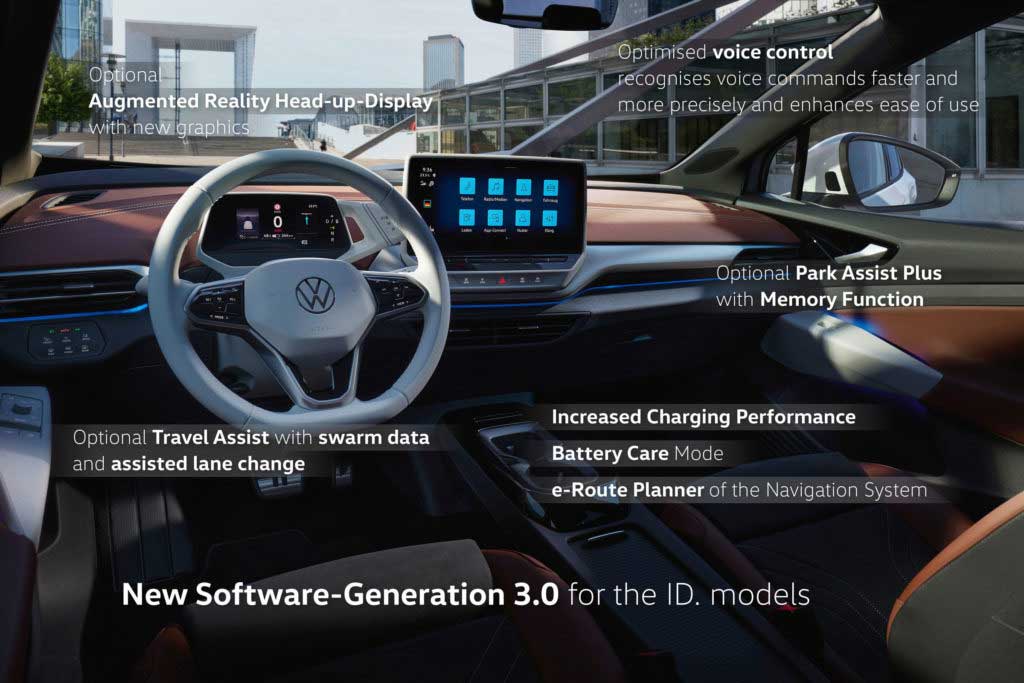
Volkswagen (VW) kommer att genomföra en stor trådlös mjukvaruuppdatering för sina ID.-elfordon. Den kommer att inkludera större laddningskapacitet som kan utöka elbilarnas räckvidd. Den har också det senaste förarassistanssystemet, förbättrad prestanda för röststyrning och parkeringsassistans som kan memorera parkeringsmanövrer.

Den trådlösa mjukvaruuppdateringen 3.0 har varit efterlängtad. Den erbjuder nya, samt valfria, uppdateringar för funktioner så som autostyrning, laddprestanda och ”AR Head-up-Display”. När det kommer till smart mjukvara för elfordon så har VW halkat efter vissa av sina huvudkonkurrenter, så som Tesla, men den nya uppdateringen ska minska det avståndet.

– Den nya ID. Software 3.0 är en uppdatering för hela vår ID.-familj, säger Thomas Ulbrich, VW styrelseledamot, med ansvar för teknisk utveckling.

– Vi tar våra produkter till en ny nivå av funktionalitet då vi jobbar snabbare, är mer uppkopplade och är mer kundorienterade.

Bildkälla: VW

Smart elbilsmjukvara

Den trådlösa mjukvaruuppdateringen utlovar en varieté av fördelar, bilmodeller med batterier på 77kWh kan nu ladda upp till 135 kW i stället för 125 kW. VW sa att förbättringar av batteriets värmehantering gör körning mer effektivt och kan utöka räckvidden. Konsumenter som vill förlänga elbilsbatteriets livslängd kan dessutom aktivera det nya ”Battery Care Mode”, vilket begränsar laddningskapaciteten till 80%.

Nya funktioner fokuserar på intelligenta system för förarassistans och inkluderar tillvalet ”Travel Assist with Swarm Data”, vilket automatiskt håller bilen mitt i körfältet och anpassar sig till körstilen. Det låter förare hålla avstånd till fordon framför sig, med hjälp av förutseende farthållare och styrassistent. Två radarsensorer baktill och ultraljud håller ett öga på trafiken och kan hjälpa till vid filbyten. Om sensorerna inte känner av några föremål svänger bilen självmant över till det intilliggande körfältet, och föraren kan närsomhelst ingripa.

Andra automatiska funktioner inkluderar ”Park Assist Plus”, vilket låter bilen leta efter en parkeringsplats och slutföra manövern med hjälp av sensorerna. Det kan även användas för att glida ut från fickparkeringar. En ytterligare minnesfunktion låter bilen lära sig specifika parkeringsvanor som den sen kan upprepa på egen hand.

Mjukvarudriven mobilitet

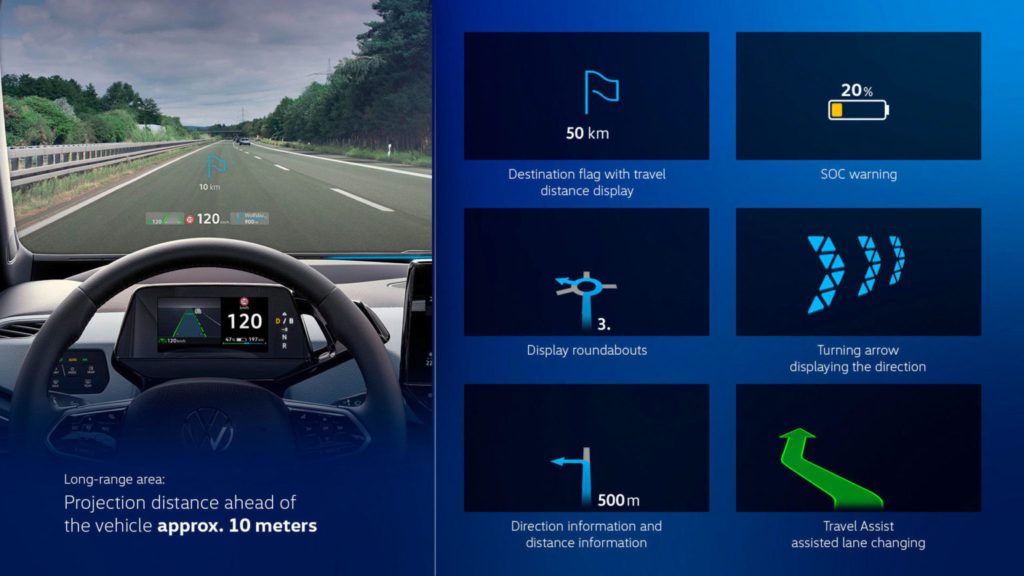
VW befinner sig mitt i en påskyndning av sin förvandling till en leverantör av mjukvarudriven mobilitet. Den senaste uppdateringen betonar deras ansträngningar – listan över nya funktioner är lång, inte minst när det kommer till AR-displayen. Uppdateringen lägger till ytterligare displayer i AR-systemet, och även nya symboler så som rondeller och information om avståndet till resmålet. Den visar också laddningsnivån och hur långt det är kvar till resmålet.

Bildkälla: VW

Biltillverkaren har förbättrat navigationen och lagt till en smart reseplanerare. Förare kommer även att få lokala varningsmeddelanden. Röststyrningen har förbättrats för att känna igen kommandon fortare. Enligt VW har bilen förvandlats till ”en intelligent samtalspartner”. Röststyrning är tillgängligt i all ID.-modeller i Tyskland. Systemet svarar i uppkopplat läge från molnet och i offline-läge från information som är sparad i bilen. VW utlovar ”hög igenkänningsgrad och kvalitet på resultaten”.

På det stora hela gör den trådlösa programvaruuppdatering att VW kan skapa en ny digital kundupplevelse med ytterligare funktioner som erbjuder mer komfort till förare. Det elektriska utbudet av ID.-modeller fortsätter att växa, något som gör smart mjukvara till en avgörande hörnsten för VW. För ungefär ett år sedan lanserade företaget sin första trådlösa uppdatering, vilket gjorde dem till den första stora fordonstillverkaren som regelbundet uppdaterade bilars mjukvara via mobil dataöverföring.

Detta innehåll presenteras till dig av Autovista24.

Vänligen notera att denna artikel är en översättning av originalet som publicerades på engelska på Autovista24´s hemsida och kan innehålla mindre grammatiska fel. I händelse av diskrepans eller inkonsekvens mellan översättningen och den engelska versionen, ska den engelska versionen alltid ha företräde.

Ta mig till Autovista24

Europas marknad för begagnade bilar står stabilt under de första tre kvartalen

Europas marknad för begagnade bilar höll ställningarna mellan första och tredje kvartalet, endast fyra av dess fem stora marknader såg ensiffriga nedgångar. Detta står i skarp kontrast till nybilsmarknaden som fortsätter att kämpa på grund av ett antal utmaningar.

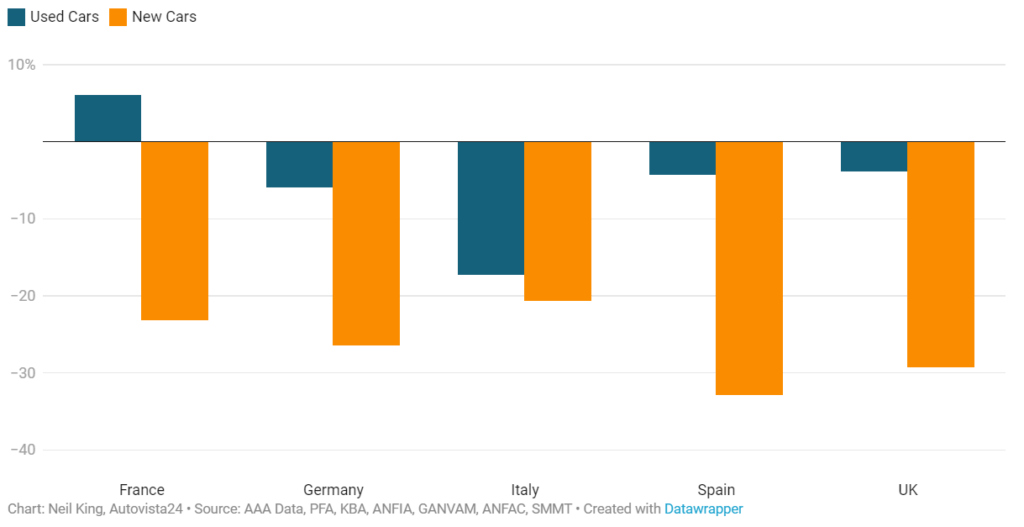
Frankrike, Spanien och Storbritannien

Av de fem stora europeiska marknaderna visade tre siffror över -5% för begagnade bilar mellan januari och september 2021 jämfört med samma period 2019. Utveclingen i Frankrike var speciellt bra med 4 575 036 affärer vilket var en ökning med 6,1% enligt AAA-data. Det här står i skarp kontrast mot nedgången på 23,2% inom nybilsförsäljningen under samma period.

Affärer med begagnade bilar och nybilsregistrering, procentuell förändring januari-september 2019 jämfört med 2021

Affärer med begagnade bilar i Storbritannien sjönk med endast 3,9% mellan första och tredje kvartalet i år jämfört med samma period 2019. Det här är ett relativt bra resultat jämfört med landets nybilsmarknad som sjönk med 29,3% under samma tidsperiod. ”Trots att marknaden för begagnade bilar minskade under tredje kvartalet innebär rekordförsäljning tidigare under året, särskilt under andra kvartalet, att marknaden fortsätter peka uppåt vid årsslutet,’ förklarade Mike Hawes, vd för SMMT.

”Med tanke på omständigheterna, med den globala pandemin som orsakar en brist på halvledare som behövs för att producera nya fordon, vilket hämmar marknaden för nya bilar, kommer affärer med begagnade bilar också alltid att bli lidande. Detta är särskilt oroande eftersom förnyelse av bilflottan – av både nya och begagnade fordon – är avgörande om vi ska ta itu med problem med luftkvalitet och koldioxidutsläpp, tillade han.

Spaniens marknad för begagnade bilar utvecklades också relativt bra, en minskning med 4,3% under årets första nio månader, jämfört med samma period 2019. Antalet nybilsregistreringar sjönk samtidigt med 32,9% under samma period, visade GANVAM’s data.

Källa: GANVAM (Autonomous regional data is reported compared with 2020)

Tyskland och Italien

På andra håll i Europa var det inte riktigt lika positivt. Italiens marknad för begagnade bilar sjönk med 17,3% mellan januari och september 2021, jämfört med två år tidigare. Detta motsvarade nästan en nedgång på 20,6% som dess nybilsmarknad drabbades av under samma period enligt ANFIA.

I Tyskland visade samtidigt de senaste siffrorna från Kraftfahrt-Bundesamt (KBA) bara en minskning med 6,7% i affärer med begagnade bilar under rapportperioden jämfört med 2019. Men precis som i Frankrike, Spanien och Storbritannien stod detta i starkare kontrast till landets nybilsmarknad, som sjönk med 27,4% mellan januari och september.

Minskat restvärdestryck

Den mer positiva utvecklingen på majoriteten av Europas fem stora marknader för begagnade bilar stödjer Autovista Groups förutsägelse som presenterades i början av året om att restvärdena står inför ett minskat tryck under 2021. Ett fortsatt varierande antal affärer och en ojämn ekonomisk framtid gör att detta sannolikt kommer att fortsätta eftersom konsumenterna letar efter ett kostnadseffektivt sätt att resa som inte innebär transporter med kollektivtrafik.

Autovista24:s senaste Monthly Market Update (MMU) visar att konsumenter byter till begagnade fordon i stor mängd, med tanke på de högre priserna och långa leveranstiderna för nya bilar. Den ökade efterfrågan på nyare begagnade modeller faller till och med över till äldre, eftersom restvärdet på tre år gamla modeller återigen höjdes i oktober.

Detta innehåll presenteras till dig av Autovista24

Så banade Norge och popbandet A-ha väg för elbilsacceptansen

José Pontes, datachef på EV-volumes.com, överväger utvecklingen av det elektriskt laddningsbara fordonet (EV). Här fokuserar han på Norge – en av elektrifieringens ”first movers” och en indikator på vad som kan ligga framför oss.

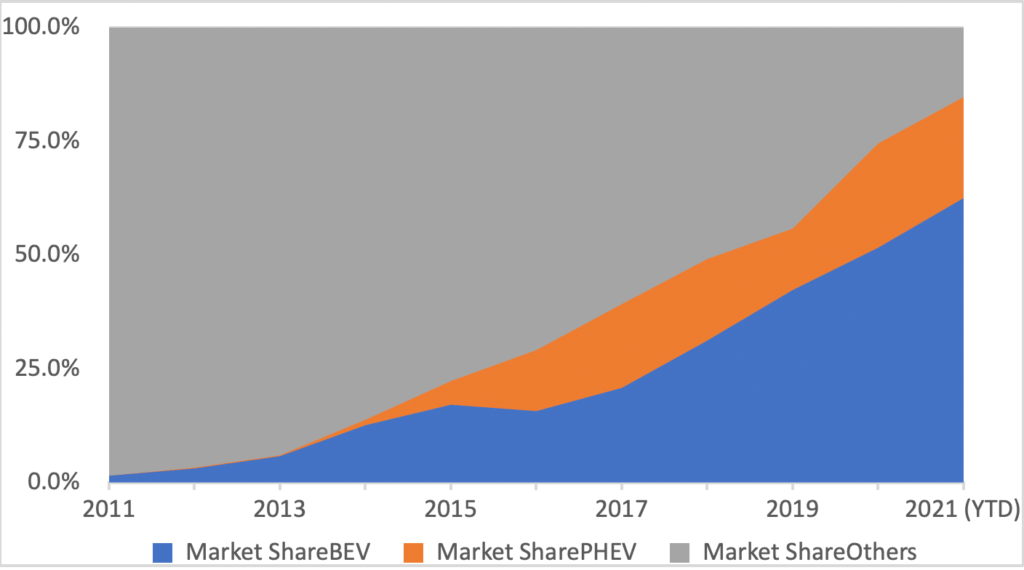
För att veta mer om de sociala och ekonomiska konsekvenserna av transportelektrifiering behöver du inte gå längre än till Norge. Med för närvarande oslagbara marknadsandelar (62,5% batteridrivna elfordon (BEV), 22,2% plug-in elhybridfordon (PHEV), 15,3% andra) i år fungerar landet som en förhandstitt på framtiden för andra regioner.

Sedan den tredje generationen av elbilen startade för ett decennium sedan, var Norge den första marknaden att nå 1% marknadsandel i nyregistreringar av tekniken 2011. Det var den första marknaden där ett elfordon blev ett av 100 passagerarfordon (2014), och den första att uppnå tvåsiffriga siffror, både i marknadsandel (2014) och fordonsflotta (2020).

Därför är det tydligt att Norge kommer att vara det första landet i världen att slutföra elektrifieringsprocessen, med den extra fördelen att 98% av all el i landet kommer från förnybara källor, särskilt vattenkraft.

Sammanfattning av Norges fordonsmarknad

Källa: EV-volumes.com

Norge är en pionjär inom vägtransportelektrifiering och landet med den mest avancerade processen. Elfordon står för närvarande för 85% av all försäljning av personbilar, medan enbart BEV står för 63% av alla registreringar.

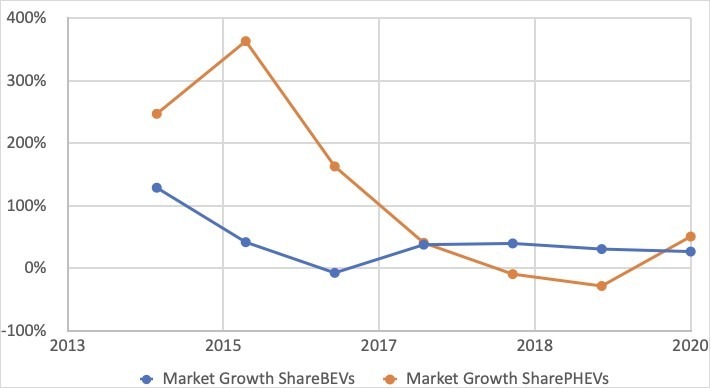
Intressant nog har PHEV:s marknadsandel varit relativt stabil sedan 2016. Samtidigt har BEV-fordon efter ett års stagnation 2016, återupptagit sin tidigare stadiga tillväxttakt. Detta är endast möjligt tack vare stabiliteten i köpincitamenten i Norge.

Räkna med att Norges elbilsandel kommer att representera nära 100% av den totala fordonsmarknaden 2023, med BEV-fordon som har mer än 95% av marknaden 2024. Detta föregriper landets 2025 mål för nollutsläppsfordon (ZEVs).

Tillväxttakten för fordon i Norge

Källa: EV-volumes.com

Som visas i det här diagrammet som dokumenterar tillväxthastigheterna för båda drivlinorna, upplevde PHEVs en brant tillväxt från 2014 till 2016, tack vare ökade incitament under andra halvan av 2013. Därefter har tekniken antingen följt den för BEV-fordon (2017 och 2020) eller sett en vikande försäljning (2018 och 2019).

BEV-fordon har, tack vare stabila incitament, upplevt en stadig tillväxt efter den klassiska jämna nedåtgående tillväxttakten på mogna marknader.

Totala flottans procentsatser

Källa: EV-volumes.com

Effekter på den totala personbilsflottan

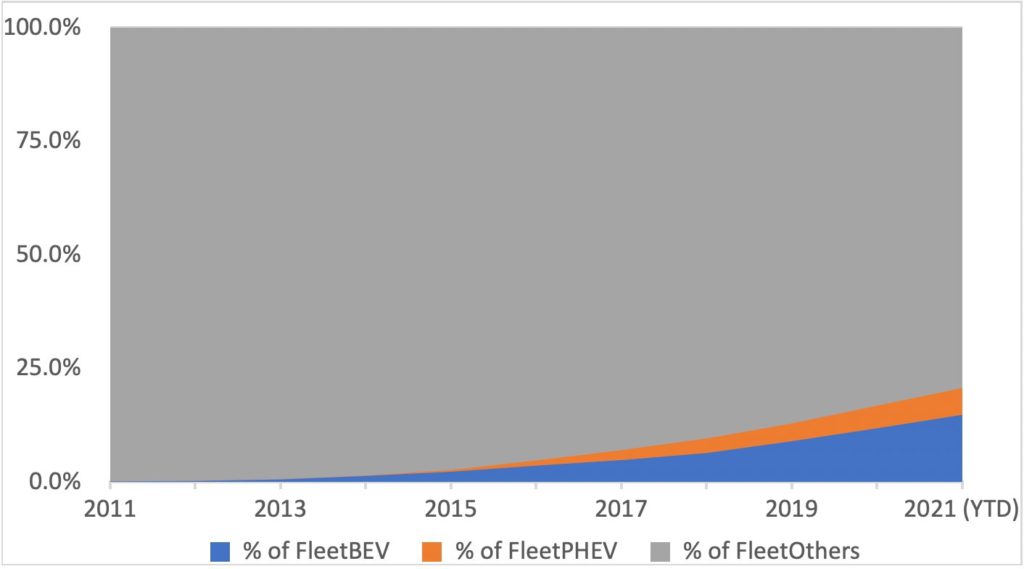
När det gäller nyregistreringar är elektrifieringsprocessen nästan klar. Att byta ut den totala flottan av personbilar kommer att ta ytterligare några år, visar grafen ovan. Medan plugin-andelen i nyregistreringar redan ligger på 85%, är samma andel i den totala flottan av personbilar fortfarande 21%.

Trots detta är effekterna av den totala förbrukningen av fossila bränslen i landet redan synliga, eftersom Norge har sett en fallande bränsleförsäljning sedan 2017, med 3-5% årlig takt.

Värt att notera är att en effekt av den minskande försäljningen av fossila bränslen delvis beror på att vissa bensinstationer redan byter ut sina tankställen med snabbladdningsstationer.

Nivå på BEV-incitament

Hur höga är incitamenten?

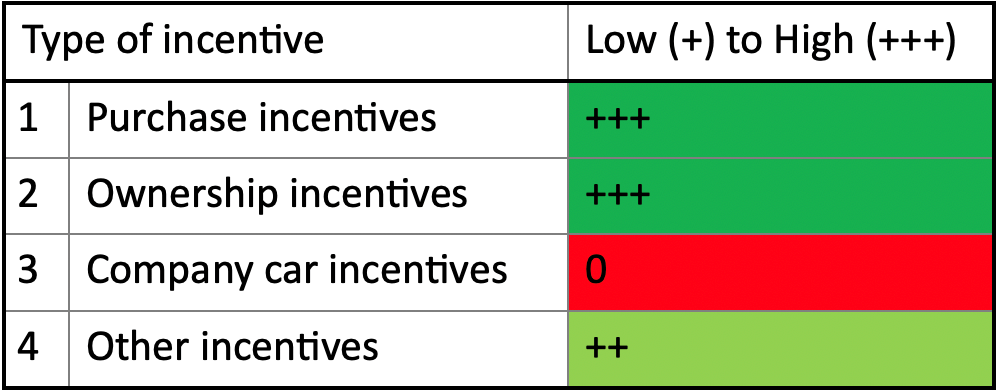
Incitamenten i Norge är betydande. Även om tjänstebilar inte har särskilda förmåner eller incitament, har BEV-fordon flera betydande incitament, inte bara vid inköpstillfället, som befrielsen från 25% moms eller registreringsskatt, utan även under bilens livstid.

Dessa förmåner inkluderar reducerad vägskatt, användning av bussfiler, gratis vägtullar, färjor och parkering. De tre sistnämnda ändrades dock 2018, då lokala myndigheter fick rätt att ändra den kostnadsfria användningen av dessa tjänster.

Några av dessa är av särskild betydelse i vissa områden i Norge, som Bergen, där gratisfärjor kan innebära en stor besparing varje månad. Att korsa fjordarna med färja kan vara dyrt, så det är ingen överraskning att i områden som Bergen nämns detta incitament som det främsta skälet att köpa en elbil. Utöver detta finns det också några indirekta incitament, som speciella registreringsskyltar eller subventioner för hemladdare. Även om PHEV är mindre betydande har de också förmåner, nämligen betydande skattesänkningar.

Noll utsläpp

En annan viktig drivkraft för förändring är nollutsläppsmandatet, som ska börja gälla 2025, då alla nya personbilar, stadsbussar och LCV-registreringar bör vara nollutsläppsfordon (ZEV). Mandatet kommer också att verkställas för långfärdsbussar och tunga lastbilar år 2030, även om kravet endast kräver en 75% ZEV-kvot för de förstnämnda och en 50%-kvot för de sistnämnda.

För närvarande pågår diskussioner om att ändra incitamenten i den norska statsbudgeten för 2022, nämligen:

  • Sänkningen av den årliga trafikskatten skulle kunna tas bort.
  • PHEV-incitamenten ska minskas avsevärt, och den minsta elektriska räckvidden ska öka från 50 km till 100 km (WLTP).
  • En ökning av koldioxidskatten.

Förmåner och incitament inkluderar befrielse från köpskatt, köpincitament, moms, befrielse från importskatt och ägarskatt, användning av bussfiler, avgiftsbefrielse, gratis parkering och gratis färjor. De kan också omfatta skattebefrielse för naturaförmåner, avdragsrätt för debiteringskostnader, särskilda registreringsskyltar och subventioner för elbilar.

BEV-fordon per laddningspunkt

Källa: EV-volumes.com

Laddningsångestförhållandet

Elbilar betyder inte mycket utan en pålitlig laddningsinfrastruktur (CI). För BEV-framgång bör tre variabler uppfyllas:

  • Priset bör ligga nära ICE-modeller.
  • Räckvidden bör räcka till för köparnas behov och på så sätt undvika räckviddsångest.
  • Det bör finnas tillräckligt med CI för att undvika laddningsångest, något som kan vara lika skadligt för elbilsacceptansen som räckviddsångesten.

CI-underhåll måste också övervägas. De officiella siffrorna förutsätter att alla laddstationer är i drift, vilket inte är realistiskt, så frekvensen av stillestånd bör också beaktas.

Samma logik gäller för EV-föraren. När föraren förbereder en bilresa måste hen ha en plan B (eller till och med plan C) om den första laddstationen är stängd.

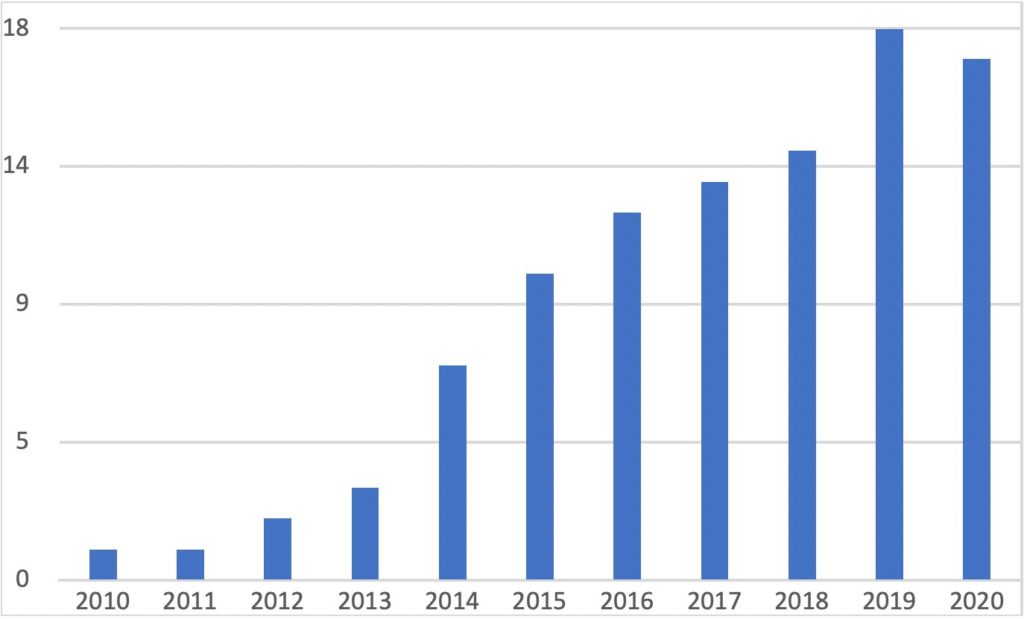
På grund av snabbare tillväxttakt i BEV-försäljningen har antalet fordon per laddplats vuxit avsevärt under åren, från två BEV-bilar per laddplats 2012, till 18 under 2019. Denna tillväxt har lett till köer vid vissa laddstationer. Lyckligtvis har CI-utvecklingen ökat avsevärt sedan dess, vilket stabiliserar detta viktiga förhållande.

Att äga en elbil blir det vanliga

Demografin för BEV-ägandet har förändrats och blivit mindre särskiljande från den totala marknaden, eftersom elbilssektorn mognar och smälter in i mainstream. En undersökning från 2016 av Transportokonomist Institutt (TOI), ett Oslo-baserat forskningscenter om ägande av elbilar, visade att familjer med BEV-fordon i genomsnitt var yngre (47 år mot 56 för ICE), högre utbildade, reste längre sträckor i arbetet (25 km mot 18 km), och ägde fler fordon per capita. Samma undersökning 2018 avslöjade att medelåldern för ägande av elbilar (51 år) kom närmare huvudmarknaden, med samma sak i de återstående indikatorerna.

Ytterligare studier visade att 59% av BEV-ägarna laddar hemma, en andel som växer till 74% för PHEV-ägare.

Intressant nog är de främsta skälen som presenteras för att köpa en BEV eller PHEV olika. Peer-to-peer-influenser identifierades som den främsta drivkraften för BEV-köp. På PHEV-sidan nämns återförsäljare och reklam som de främsta anledningarna till köp.

A-ha och en Fiat Panda

Vid första anblicken verkar det kalla klimatet i Norge inte vara det bästa stället att starta elbilsrevolutionen på, men vissa faktorer stämde överens. En av dem hade att göra med det norska popbandet a-ha och en Fiat Panda.

1989 tog två av bandmedlemmarna med sig en privatkonverterad Fiat Panda till Norge. När de körde genom Oslo vägrade de att betala vägtullar och efterföljande böter, i protest mot bristen på incitament för elbilar.

Den lilla Pandan konfiskerades mer än en gång, men när den auktionerades ut för att betala böterna ville ingen annan köpa bilen, så de två bandmedlemmarna köpte tillbaka den igen för ett symboliskt pris.

Detta hände mer än en gång och dessa bisarra händelser fick medieuppmärksamhet, stärkte elbilens popularitet och ledde slutligen till starten av elbilsincitamenten 1990 med en befrielse från importskatten.

Från och med då började elbilsrörelsen få en viss dragkraft och ytterligare incitament introducerades under 1990-talet. Detta gav ett lokalt startupföretag, Pivco, en snabbstart för att utveckla och introducera den lilla PIV3-modellen 1995. Det lilla norska företaget tillverkade 120 enheter, vilket motiverade dem att skapa en ny, mer kapabel modell, som de kallade PIV4.

Men utan tillräckliga intäkter för att finansiera sin utveckling hamnade företaget i allvarliga ekonomiska problem när den nya modellen var klar 1999. Ford förvärvade verksamheten och förvandlade PIV4 till Think City, med produktionen av elbilar i småstaden som startade 2001.

Efter bara ett år, 2002, efter 1 005 tillverkade enheter fick de förändrade vindarna i USA:s politik projektet att avslutas. Enheter som sålts i USA och Storbritannien återexporterades till Norge, den enda plats där elbilar fortfarande hade en efterfrågan i mitten av 2000-talet.

Återigen tog norska entreprenörer initiativet till att återuppliva den lilla elbilen och i november 2007 återupptogs produktionen av en ny och förbättrad Think City som såldes i 100 enheter på lite mindre än ett år.

2011 tjänade Norge på dessa tidigare ansträngningar och incitament för att bli en av fokusmarknaderna för introduktionen av en ny generation elbilar, som Nissan Leaf och Mitsubishi I-Miev.

Det var då som elbilsmarknaden började utvecklas mer markant. Även om incitamenten och laddinfrastrukturen redan fanns på plats, saknades det tilltalande modeller. Försäljningen växte från de tidigare hundra fordonen per år till över 2 000 enheter 2011. Volymerna överskred tröskeln på 1% marknadsandel, vid en tidpunkt då de flesta andra marknader fortfarande bara hade en symbolisk försäljning.

Detta innehåll presenteras till dig av Autovista24

Ta mig till Autovista24